Indeed vs LinkedIn: Which Platform Works Better for Jobs in 2026?
In 2026, job seekers have more options than ever but two platforms still lead the way: LinkedIn and Indeed.
So when it comes to LinkedIn vs Indeed, which one actually helps you get hired?
Indeed is a job-first platform built to help candidates quickly find and apply to open roles.
LinkedIn goes beyond job listings, combining opportunities with networking, personal branding, and direct access to recruiters especially when paired with insights from the best LinkedIn analytics tools and modern workflows powered by the best AI tools for LinkedIn.
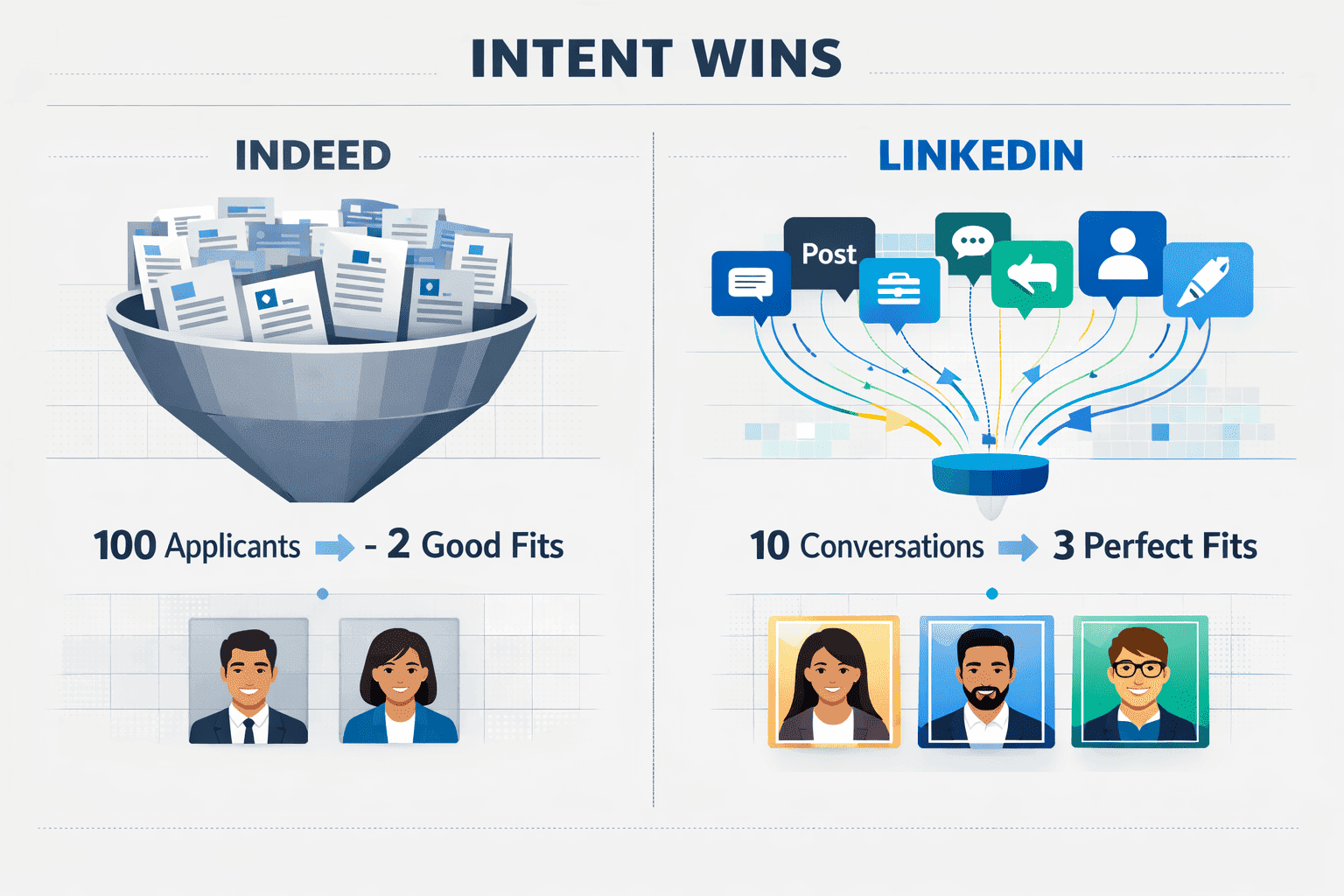
Both are powerful. But they work very differently and knowing when to use each can make all the difference in your job search.
The Short Answer
LinkedIn wins for networking, relationship building, and high-level roles. It's where you connect with decision-makers and get found by recruiters.
Indeed wins for volume, quick applications, and entry-to-mid level positions. It's a fast way to apply to many jobs at once.
But that's just the surface. Let's dig deeper into which platform actually delivers better results for different types of job searches.
LinkedIn vs Indeed: The Numbers
| Factor | Indeed | |
|---|---|---|
| Total Jobs | 25M+ active listings | 40M+ active listings |
| Professional Focus | High (95% white collar) | Mixed (60% white collar) |
| Application Rate | Lower (more selective) | Higher (bulk applications) |
| Response Rate | 2-5x higher on average | Standard industry rate |
| Salary Levels | Generally 15-30% higher | Full range |
| Geographic Coverage | Global, US-focused | Global, local-focused |
Note: Numbers based on 2024-2025 industry reports and platform data
When LinkedIn Beats Indeed
1. Higher-Level Positions ($75k+)
LinkedIn dominates in senior roles and executive positions. Here's why:
- Recruiters live on LinkedIn: 87% of executive recruiters use LinkedIn as their primary platform
- Direct access to hiring managers: You can often connect directly with the people making hiring decisions
- Professional context: Your entire professional story is visible, not just your resume
Example: Sarah, a marketing director, found her VP role through a LinkedIn connection who saw her thought leadership content. This type of discovery rarely happens on Indeed.
2. Industry Networking Effects
Some industries heavily favor LinkedIn networking:
- Technology: 73% of tech hires involve LinkedIn connections
- Consulting: Most senior consulting roles come through referrals
- Sales: Sales roles often require demonstrable professional networks
- Finance: Many finance positions value LinkedIn presence as a professional credibility signal
3. Passive Job Searching
LinkedIn excels when you're employed but open to opportunities:
- Recruiter discovery: Set yourself as "open to work" privately
- Warm introductions: Mutual connections can facilitate introductions
- Industry insights: Stay current on trends while job searching
The guide to social listening on LinkedIn shows how staying engaged with industry conversations can attract opportunities.
When Indeed Beats LinkedIn
1. High-Volume Job Searching
Indeed's strength is sheer volume and application speed:
- More job listings: 40M+ vs LinkedIn's 25M+
- Faster applications: Apply to 10+ jobs in the time it takes to craft one LinkedIn message
- Local opportunities: Better coverage of local and regional employers
- Entry-level roles: More positions that don't require extensive networking
2. Specific Job Types
Indeed dominates in certain categories:
- Hourly positions: Restaurant, retail, manufacturing, healthcare support
- Government jobs: Many government positions are posted exclusively on Indeed
- Small business hiring: Local companies that don't actively use LinkedIn
- Contract/temporary work: Indeed has better temporary and contract job coverage
3. Quick Career Pivots
When you need a job fast and are willing to consider various options:
- Salary filters: Quickly filter by compensation requirements
- Location radius: Find jobs within your commute preferences
- Application tracking: Better tools for managing large numbers of applications
LinkedIn vs Indeed: The Hybrid Approach
Smart job seekers use both platforms strategically:
Week 1-2: LinkedIn Foundation
- Update your LinkedIn profile completely
- Connect with former colleagues and industry contacts
- Set up job alerts for dream companies
- Begin engaging with industry content
Week 3+: Indeed Volume
- Set up comprehensive Indeed job alerts
- Apply to 10-15 relevant positions weekly
- Use Indeed's salary insights for negotiation preparation
- Track applications in Indeed's built-in system
Ongoing: LinkedIn Networking
- Share industry insights 2-3x per week
- Comment thoughtfully on posts from target companies
- Send connection requests to people at companies you're interested in
- Use LinkedIn automation tools for consistent but genuine engagement
The Data: Which Platform Gets Better Results?
Based on 2024-2025 job search outcome studies:
LinkedIn Advantages:
- Higher response rates: 3-5% vs Indeed's 1-2%
- Better salary outcomes: 15-30% higher on average
- Stronger employer engagement: 67% of LinkedIn applications get viewed vs 23% on Indeed
- Networking multiplier: 85% of LinkedIn hires involve some networking component
Indeed Advantages:
- Faster initial contact: Average 2-3 days vs LinkedIn's 5-7 days
- More interview opportunities: Higher volume = more chances
- Local market penetration: Better coverage in smaller markets
- Application completion rate: 89% vs LinkedIn's 45%
Industry-Specific Recommendations
Technology Jobs
- Primary: LinkedIn (networking crucial)
- Secondary: Indeed (volume applications)
- Special focus: GitHub integration, technical content sharing
Healthcare Jobs
- Primary: Indeed (most postings)
- Secondary: LinkedIn (senior roles only)
- Special focus: License verification, local opportunities
Sales Jobs
- Primary: LinkedIn (relationship building essential)
- Secondary: Indeed (inside sales, SDR roles)
- Special focus: Demonstrate network building skills
Finance Jobs
- Primary: LinkedIn (relationship-driven)
- Secondary: Indeed (entry-level, operations roles)
- Special focus: Professional credentials, thought leadership
Education Jobs
- Primary: Indeed (most school districts post here)
- Secondary: LinkedIn (administration, higher ed)
- Special focus: Teaching philosophy, educational content
LinkedIn vs Indeed: Hidden Optimization Tips
LinkedIn Optimization:
- Keyword optimization: Use the same terms employers search for
- Activity signals: Regular engagement signals job search intent to algorithms
- Connection quality: 500+ connections with 70%+ from your target industry
- Content strategy: Share industry insights, not personal updates
The best LinkedIn lead generation guide offers techniques that also work for job searching.
Indeed Optimization:
- Resume keywords: Match job description language exactly
- Application timing: Apply within 24-48 hours of posting
- Profile completion: 100% complete profiles get 40% more views
- Salary expectations: Be realistic but don't undervalue yourself
Common Mistakes: LinkedIn vs Indeed
LinkedIn Mistakes:
- Generic connection requests
- Over-promotion in job search posts
- Neglecting to engage with others' content
- Using LinkedIn like a job board instead of a networking platform
Indeed Mistakes:
- Applying to jobs outside your qualifications
- Generic cover letters
- Not using Indeed's salary tools for research
- Ignoring company research available on Indeed
The ROI Analysis: Time Investment vs Results
LinkedIn Time Investment:
- Daily: 30-45 minutes (engagement, messaging)
- Weekly: 2-3 hours (content creation, profile updates)
- Expected results: 2-5 quality opportunities per month
Indeed Time Investment:
- Daily: 15-20 minutes (application submission)
- Weekly: 1-2 hours (new job alerts, profile maintenance)
- Expected results: 5-15 application responses per month
LinkedIn vs Indeed in 2026: What's New?
LinkedIn 2026 Updates:
- Enhanced AI matching between candidates and jobs
- Better integration with company culture data
- Improved privacy controls for active job searching
- Stronger emphasis on skills-based matching vs degree requirements
Indeed 2026 Updates:
- Better salary transparency tools
- Enhanced local job matching
- Improved application tracking and follow-up systems
- Integration with more ATS systems for faster applications
The Verdict: LinkedIn vs Indeed for Jobs in 2026
Choose LinkedIn when:
- Targeting roles above $75k annually
- Industry connections matter for your field
- You have time to invest in relationship building
- You're currently employed but exploring options
- Your target companies have strong LinkedIn presence
Choose Indeed when:
- Need a job quickly with high application volume
- Targeting entry to mid-level positions
- Geographic location is a primary factor
- Industry networking is less critical
- Time for job searching is limited
Use both when:
- Serious about finding the best possible opportunity
- Can invest 1-2 hours daily in job search activities
- Target salary range is $50k-$150k (where both platforms overlap)
- Industry has good representation on both platforms
Get more out of LinkedIn for your job search. OutX offers free tools like auto-liking to boost your visibility, a profile viewer to check how recruiters see you, and social listening to track job-related keywords and mentions across LinkedIn.
Bottom Line
In 2026, LinkedIn vs Indeed isn't really a choice. It's about understanding when each platform serves your goals best.
Indeed remains the volume play: more jobs, faster applications, broader coverage.
LinkedIn is the relationship play: better connections, higher-quality opportunities, stronger long-term career building.
The most successful job seekers use LinkedIn to build their professional brand and network while using Indeed to ensure they're not missing opportunities in their local market or target companies.
Your industry, career level, and time availability should determine how you balance these two platforms. But in today's competitive job market, using only one is likely leaving opportunities on the table.
Ready to optimize your job search strategy? Start by auditing your presence on both platforms and developing a weekly routine that leverages the unique strengths of each.
Looking to enhance your LinkedIn strategy further? Explore LinkedIn sales navigator scraping techniques that job seekers can adapt for research, or discover LinkedIn monitoring tools that help track industry conversations and opportunities.
.png&w=3840&q=75)
.png&w=3840&q=75)