Apify Alternatives in 2026: 7 Tools Compared (Free vs Paid)
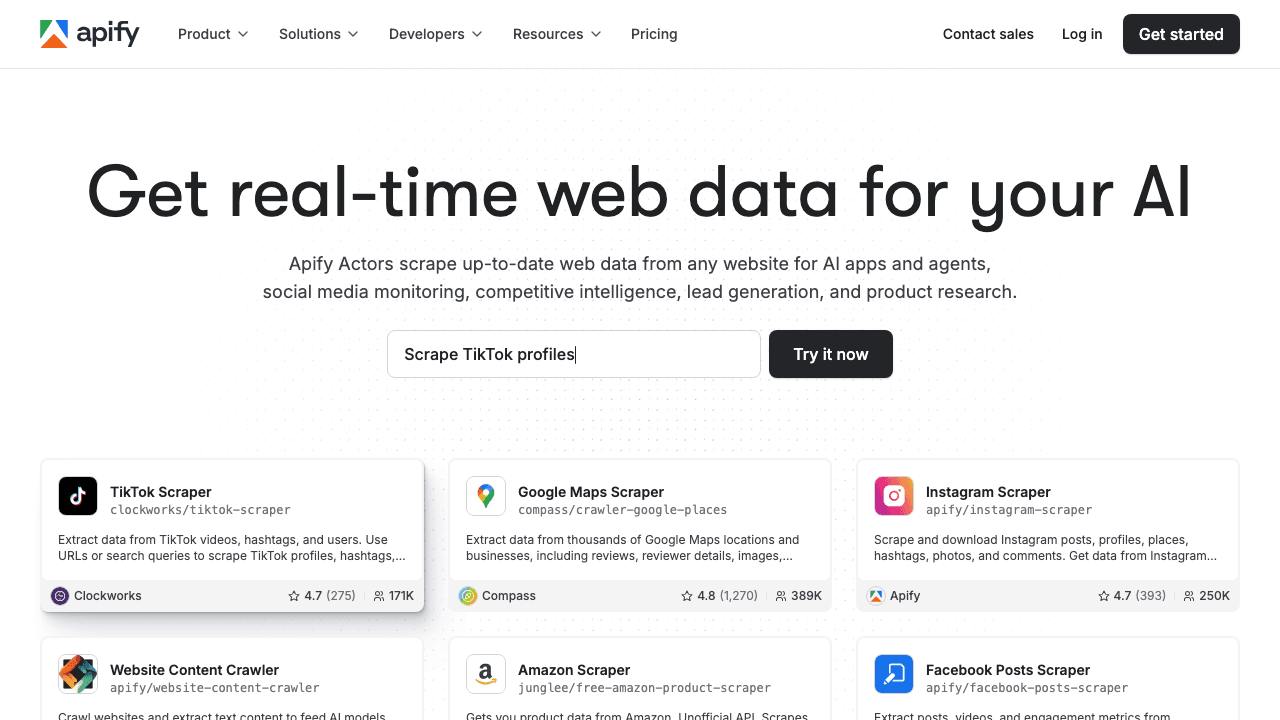
Apify is a full-stack scraping platform with 27,000+ pre-built Actors, a developer-friendly SDK, and a marketplace that covers almost any website you want to extract data from. The catch is the compute-unit pricing model, which generates surprise bills for resource-intensive Actors, and the variable quality of community-maintained Actors. Here are seven alternatives, plus the important context on OutX if your Apify use case is LinkedIn data specifically.
Quick comparison
Seven Apify alternatives, prices in USD.
| Tool | Pricing | Best for | Free tier |
|---|---|---|---|
| Apify | Free ($5 credits); Starter $29/mo; Scale $199/mo | Developers needing full-stack cloud scraping with a massive Actor marketplace | Yes |
| OutX (recommended) | Free; from $99/mo | Native LinkedIn data API + buying-signal engagement | Yes |
| Bright Data | Custom; pay-as-you-go available | Enterprise proxy infrastructure and large-scale web data extraction | No |
| Octoparse | Free (non-commercial); from ~$89/mo | Non-technical teams needing no-code visual scraping | Yes |
| PhantomBuster | Free (2 hours/mo); from $56/mo | LinkedIn and social media automation for lead generation | Yes |
| n8n | Self-hosted free; Cloud from $24/mo | Technical teams wanting open-source workflow automation with scraping | Yes |
| Oxylabs | From ~$99/mo | Enterprise proxy network for large-scale scraping operations | No |
| Fivetran | Custom; consumption-based | Data engineering teams building structured SaaS data pipelines | No |
Why people look for Apify alternatives
Apify is a powerful tool with high developer satisfaction (4.7/5 on G2). The reasons teams switch:
- Surprise bills from the compute-unit model. Some Actors are resource-intensive. The pay-as-you-go overage on top of the monthly plan can spike unexpectedly for large runs. Teams on the $29/month Starter plan hit the $200/month territory faster than expected.
- Community Actor quality variance. The 27,000+ Actor marketplace includes Actors with months between last commits and no maintenance owner. When a target site changes, those Actors break and you are on your own.
- Not suitable for non-developers. The learning curve requires JavaScript or Python familiarity, web scraping concepts, and comfort with infrastructure configuration. Non-technical users find it overwhelming.
- LinkedIn scraping is unreliable. LinkedIn actively blocks scrapers and updates detection regularly. Apify's LinkedIn Actors break frequently, and using the data may violate LinkedIn's ToS.
7 Apify alternatives, in detail
1. OutX (official LinkedIn data, no scraping)
Category: LinkedIn social listening + personal branding Pricing: Free; paid from $99/mo Best for: Native LinkedIn data API + buying-signal engagement
If your Apify use case is LinkedIn specifically, OutX is the direct answer to the scraping problem. LinkedIn aggressively blocks scrapers. When the scraper breaks (and it breaks regularly when LinkedIn updates its front-end), you need to fix the Actor or find a maintained replacement. OutX uses LinkedIn's official data pipeline, which means no ban risk, no ToS violations, and no maintenance burden when LinkedIn changes its interface.
Beyond just the data: OutX is built around buying signals, not just data extraction. You get LinkedIn data plus the alert layer that tells you when something meaningful happens on your watchlist. For teams that scrape LinkedIn to find buying opportunities, OutX replaces the scraper and adds the signal layer in one product.
Try OutX free for 7 days (cancel anytime).
2. Bright Data
Category: Web Data / Proxy Infrastructure Pricing: Custom; pay-as-you-go available Best for: Enterprise teams needing the most robust anti-bot bypass and proxy infrastructure
Bright Data is the enterprise alternative when you need industrial-scale scraping with maximum reliability. Their proxy network (residential, mobile, datacenter) is the deepest available and is built to handle the most aggressive anti-bot systems. Rated the top Apify alternative on G2.
The trade-off: no pre-built Actor marketplace like Apify. You are buying proxy infrastructure and data delivery tooling, not ready-made scraping recipes. This is the right choice for engineering teams with a dedicated data infrastructure function.
3. Octoparse
Category: No-Code Web Scraping Pricing: Free (limited, non-commercial use); paid from ~$89/month Best for: Non-technical marketers and researchers who need point-and-click scraping
Octoparse is the opposite of Apify in user experience: no code, visual task builder, and a template library for common scraping scenarios. If the Apify barrier was technical, Octoparse is the answer.
The limitation is power. For complex scraping scenarios, JavaScript-heavy sites, or high-volume operations, Octoparse hits ceilings that Apify does not. The free tier exists for non-commercial use, which is useful for personal research or testing.
4. PhantomBuster
Category: LinkedIn / Social Automation Pricing: Free (2 hours/month); paid from $56/month Best for: Sales and marketing teams automating LinkedIn and social media data extraction
PhantomBuster is the most common Apify alternative for specifically LinkedIn and social media workflows. It has pre-built "Phantoms" for LinkedIn connection requests, profile scraping, post engagement extraction, and lead generation. The free plan gives enough access to test before paying.
The honest note: PhantomBuster is also running into LinkedIn's anti-bot policies. Accounts get flagged for automation. The risk profile is better than raw scraping but not zero. OutX's official API approach is the lower-risk option for LinkedIn specifically.
5. n8n
Category: Workflow Automation / Web Scraping Pricing: Self-hosted free; Cloud from $24/month Best for: Technical teams wanting open-source, self-hostable workflow automation with scraping capabilities
n8n is the open-source workflow automation tool that includes scraping capabilities as part of a broader automation library. Self-hosting is free. Cloud plans start at $24/month. For teams that want to own their automation infrastructure without paying a per-execution tax, n8n is appealing.
The learning curve is similar to Apify for developers. The key advantage is the broader ecosystem: n8n connects scraping to downstream workflows (CRM updates, Slack notifications, database writes) natively, where Apify focuses primarily on the extraction layer.
6. Oxylabs
Category: Proxy Network / Web Data Pricing: Pay-as-you-go; starting ~$99/month Best for: Enterprise teams needing residential and datacenter proxies for large-scale scraping
Oxylabs is the proxy infrastructure play, similar to Bright Data. It provides the proxy layer (residential, datacenter, rotating) that makes large-scale scraping work against anti-bot systems. No pre-built scraping recipes; you bring your own scraper and use Oxylabs as the proxy layer.
Better suited for teams with existing scraping infrastructure that need to upgrade the proxy quality, rather than teams starting from scratch.
7. Fivetran
Category: ETL / Data Pipeline Pricing: Custom; consumption-based Best for: Data engineering teams building structured pipelines from SaaS sources into data warehouses
Fivetran and Apify overlap only at the edges: both move data from sources to destinations. Fivetran handles structured SaaS sources (Salesforce, Stripe, Postgres) with pre-built connectors, not unstructured web scraping. If your Apify use case was actually pulling data from a SaaS API into your data warehouse, Fivetran is the better-maintained choice for that workflow.
Bottom line
- Developer needing broad web scraping: Apify is often the right answer. The alternatives mostly serve specific sub-use cases.
- LinkedIn data specifically (no scraping ban risk): OutX.
- LinkedIn/social automation: PhantomBuster (some ban risk) or OutX (no ban risk).
- No-code scraping for non-technical users: Octoparse.
- Enterprise proxy infrastructure: Bright Data or Oxylabs.
- Open-source self-hosted workflow automation: n8n.
- Structured SaaS data pipelines: Fivetran.
The LinkedIn use case is the one worth calling out specifically. If you are using Apify Actors to scrape LinkedIn profiles, search results, or post data, you are on borrowed time. LinkedIn updates its detection regularly, and data obtained this way is in a gray area legally. OutX is the cleaner path for anyone in that situation.