Clay Alternatives in 2026: 7 Tools Compared (Free vs Paid)
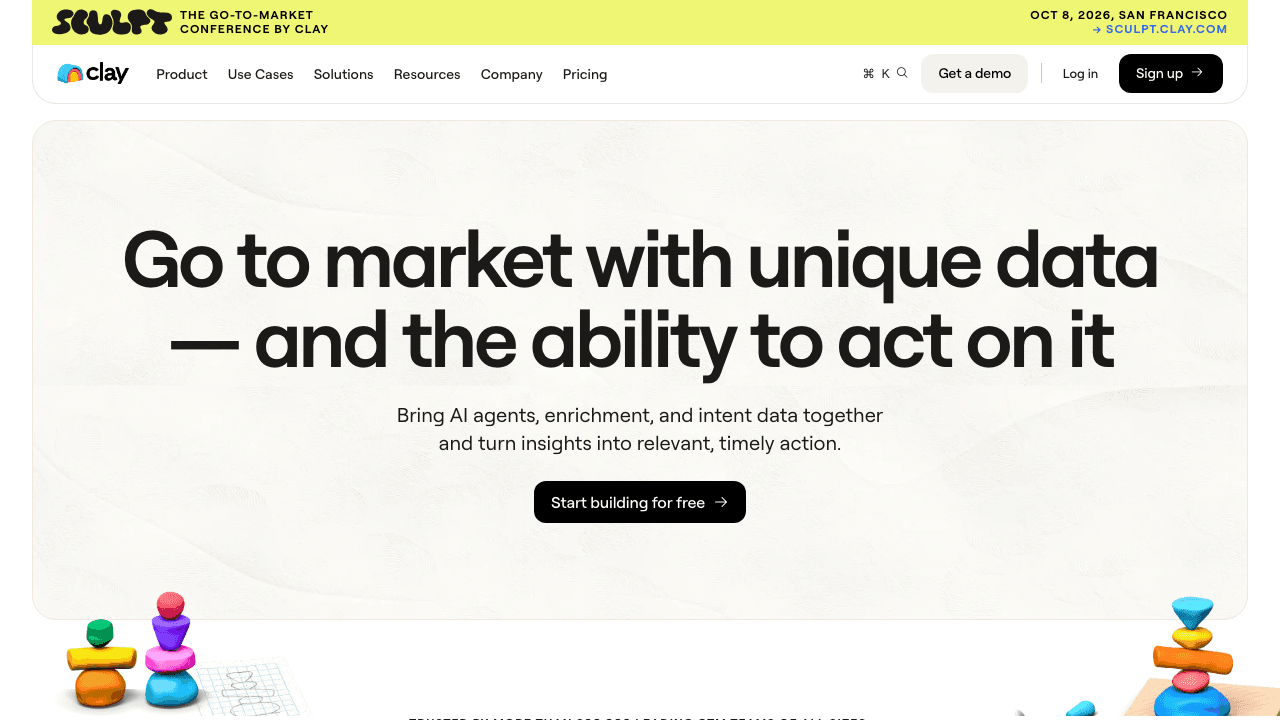
Clay is the tool of choice for RevOps teams that want to aggregate 150+ data providers in waterfall sequences and orchestrate end-to-end GTM workflows with AI research. It is also famously complex: the number one G2 complaint is the learning curve, with first-time users spending 5-6 hours on a single workflow. If the complexity, the credit-based pricing model, or the need for technical RevOps expertise has made Clay impractical for your team, here are the seven alternatives worth evaluating in 2026.
Quick comparison
Seven alternatives, prices in USD, sorted by fit for teams evaluating Clay.
| Tool | Pricing | Best for | Free tier |
|---|---|---|---|
| Clay | Free; from $185/mo | RevOps teams building sophisticated multi-source enrichment workflows | Yes |
| OutX (recommended) | Free; from $99/mo | LinkedIn signals to feed your enrichment workflows | Yes |
| Apollo.io | Free; from $49/user/mo | Teams wanting data + sequencing without custom workflow building | Yes |
| ZoomInfo | From ~$15,000/yr | Enterprise teams wanting one database without building workflows | Lite |
| Cognism | ~$22,500-$50,000/yr | EU teams needing verified phone data without enrichment complexity | No |
| n8n | Free self-hosted; from $24/mo | Technical teams wanting Clay-style automation with self-hosting and no data credit costs | Yes |
| Clearbit (HubSpot) | Included in HubSpot or custom | HubSpot-centric teams needing CRM enrichment without workflow tooling | No |
| Lusha | Free; from $37/mo | Individual SDRs wanting quick lookups without workflow orchestration | Yes |
Why people look for Clay alternatives
Clay is intentionally powerful and intentionally complex. The alternatives searches come from teams that experience the complexity without seeing the payoff:
- Steep learning curve. G2's number one complaint: 16 separate mentions of learning curve difficulty, with first-time users spending 5-6 hours building their first workflow. Teams without dedicated RevOps capacity get stuck here.
- Pricing is complex to estimate. Two billing dimensions: Actions (platform operations, under $0.01 each) and Data Credits (actual data cost, $0.05+ each). Estimating what a campaign will cost before running it requires experience with both dimensions.
- Not for non-technical users. Clay requires workflow logic understanding, comfort with APIs, and data manipulation skills. Marketing generalists without RevOps support consistently struggle.
- Expensive at high volume. Combining multiple data sources at scale across large account lists can accumulate significant credit costs, especially if enrichment waterfalls are not well-optimized.
- Actions do not roll over. Unused Actions at end of billing cycle are forfeited. Data Credits do roll over.
7 Clay alternatives, in detail
1. OutX (the LinkedIn signal option)
Category: LinkedIn social listening + buying-signal engagement Pricing: Free; paid from $99/mo Best for: RevOps and sales teams adding a real-time signal layer to their enrichment workflows
Clay builds the "who to reach and how to personalize" layer. OutX builds the "when they are actively looking" layer.
The combination is powerful: Clay enriches your target account list with accurate data and AI-personalized context. OutX monitors those same accounts on LinkedIn for the moment they signal in-market behavior, "we are evaluating [your category]," "switching from [competitor]," or "looking for recommendations." When OutX fires, you can engage that account in real time with context you already built in Clay.
This is not a replacement for Clay. It is the timing layer that makes Clay's enrichment actually matter.
Try OutX free for 7 days (cancel anytime).
2. Apollo.io
Category: Sales intelligence and email sequencing Pricing: Free; from $49/user/mo Best for: Teams that want data and outreach without building custom workflows
Apollo is Clay's most recommended alternative for teams that don't have RevOps sophistication: 210M+ contacts, built-in email sequencing, dialer, and free tier. You get started in minutes rather than hours. The trade-off: Apollo is one data source vs Clay's 150+, so hit rates are lower on coverage. For teams where the complexity trade-off is not worth it, Apollo is the 80/20 answer.
Many mature teams use Apollo within Clay as a data source rather than as a replacement.
3. ZoomInfo
Category: B2B contact data and GTM intelligence Pricing: Custom, from approximately $15,000/year Best for: Enterprise teams that want a single premium database without building workflows
ZoomInfo is Clay's enterprise alternative for teams that want the highest quality data without workflow complexity. Buy the contract, search for contacts, export. $15,000+/year minimum, annual-only, but zero learning curve for the data access itself. For teams where accuracy is the constraint and budget is not, ZoomInfo is simpler than Clay.
4. Cognism
Category: B2B contact data, EU-focused Pricing: Custom, approximately $22,500-$50,000/year Best for: EU-heavy teams that need verified phone data without building enrichment waterfalls
Clay can include Cognism as one of its 150+ waterfall sources to get Cognism-quality data where it is strongest without Cognism's full contract cost. But for teams where EU phone accuracy is the primary need and RevOps workflow complexity is not desired, Cognism standalone solves the specific problem more simply.
5. n8n
Category: Open-source workflow automation Pricing: Free self-hosted; Cloud from $24/mo Best for: Technical teams that want Clay-style automation with maximum flexibility and lower data costs
n8n is an open-source workflow automation platform that can replicate Clay's enrichment logic with custom integrations. Self-hosting is free; you pay only for actual data provider APIs you integrate. For developer-led teams that have the engineering investment to build custom enrichment pipelines, n8n offers more flexibility at lower recurring cost. The trade-off: no pre-built data provider library. You build every integration yourself.
6. Clearbit (HubSpot)
Category: B2B data enrichment Pricing: Included in HubSpot Marketing Hub or custom pricing Best for: HubSpot-centric teams needing CRM enrichment without separate workflow tooling
Clearbit (acquired by HubSpot in 2023) provides CRM enrichment for HubSpot customers: real-time person and company data appended to your contacts automatically. For teams already invested in HubSpot, Clearbit covers the CRM enrichment use case without Clay's complexity. Less powerful for multi-source waterfall enrichment, but much simpler for HubSpot-native workflows.
7. Lusha
Category: B2B contact data Pricing: Free (40 credits/mo); from $37.45/user/mo Best for: Individual SDRs that want quick contact lookups without workflow orchestration
Lusha is the minimal-complexity end of the spectrum from Clay: Chrome extension, find the contact on LinkedIn, reveal the email. No workflow logic, no credit dimension complexity, no waterfall setup. For individual SDRs doing manual outreach research, Lusha's simplicity is the right trade-off. Clay is overkill for this use case.
Side-by-side: Apollo vs Clay (the most common practical comparison)
| Axis | Winner | Why |
|---|---|---|
| Speed to first value | Apollo | Start sending within minutes. Clay requires hours of setup. |
| Data coverage (single source) | Apollo | 210M+ contacts as one consistent database. |
| Data quality (waterfall) | Clay | Aggregating 150+ providers gets higher hit rates than any single source. |
| Non-technical accessibility | Apollo | Clay requires workflow logic comfort. Apollo is point-and-click. |
| Cost at scale | Clay (if optimized) | Waterfall reduces credit waste vs paying for high-tier Apollo. |
| Built-in sequencing | Apollo | Included. Clay needs a separate tool for email sending. |
| LinkedIn buying signals | Neither (try OutX) | Both are data tools. Neither monitors real-time LinkedIn intent signals. |
Where OutX fits in
Clay is built for the question "who should I reach and what should I say?" OutX is built for the question "which of those people is actively looking right now?"
Clay's power is in enrichment quality and personalization at scale. The gap Clay cannot fill is timing: even the most perfectly enriched and personalized outreach is cold if it arrives before or after the buying window. OutX catches the window.
For RevOps teams running Clay, adding OutX creates a feedback loop: Clay builds the enriched account list, OutX monitors those accounts for buying signals, and when a signal fires, the account gets moved to the front of the outreach queue with real-time context.
This is a genuine upgrade to a Clay workflow rather than an alternative to it.
Bottom line
- RevOps teams with technical sophistication wanting maximum hit rates: Clay.
- Teams wanting data + sequencing without workflow complexity: Apollo.
- Enterprise teams wanting simplicity over configurability: ZoomInfo.
- EU-heavy teams needing verified phone data: Cognism.
- Developer-led teams wanting self-hosted workflow flexibility: n8n.
- HubSpot-centric teams needing CRM enrichment: Clearbit.
- Individual SDRs wanting simple lookups: Lusha.
- Teams wanting LinkedIn buying signals to trigger their outreach: OutX (alongside any of the above).
The mistake is choosing Clay and not investing the RevOps time to use it properly. The equally common mistake is choosing any enrichment tool and ignoring the timing signal that OutX provides.