Taplio Alternatives in 2026: 6 Tools Compared (Free vs Paid)
Taplio is the established AI-powered LinkedIn content tool: scheduling, analytics, AI content generation, and a lead database on Pro. G2 4.6/5 and Capterra 4.7/5 from creators who built it into their routines. The complaints are also consistent: AI content that feels generic, cookie-based authentication that has triggered LinkedIn warnings, and a Standard plan AI credit cap that heavy users hit by mid-month. If any of those are your issue, here are six alternatives for 2026.
Quick comparison
Six Taplio alternatives, prices in USD.
| Tool | Pricing | Best for | Free tier |
|---|---|---|---|
| Taplio | $39-149/mo | All-in-one LinkedIn content + analytics + AI | No |
| OutX (recommended) | Free; from $99/mo | LinkedIn engagement intelligence, not just content creation | Yes |
| Shield Analytics | $25/mo | Data-first creators who write their own posts | No |
| AuthoredUp | $19.95-29.95/mo | Writers who want a better LinkedIn composer | No |
| Supergrow | $19-139/mo | Budget-first AI content + scheduling | No |
| Hypefury | $19-49/mo | X-first creators who also post on LinkedIn | No |
| Buffer | Free; from $6/channel | Multi-platform scheduling basics | Yes |
Why people look for Taplio alternatives
Taplio has genuine fans. The frustrations that drive alternatives searches:
- AI content feels generic. Multiple reviews on G2 describe the AI-generated posts as formulaic or easy to identify as AI. For creators who built a brand on authentic voice, this is a real problem.
- Cookie-based authentication. Taplio authenticates via cookies rather than the LinkedIn API, which has resulted in LinkedIn warnings for some users. It is less risky than outreach automation but still a yellow flag.
- AI credit cap on Standard. The Standard plan ($65/mo) allows 250 AI credits per month. Heavy users who draft multiple posts per day run out regularly.
- Lead database locked to Pro. The prospecting feature that makes Taplio interesting for sales-minded creators is only available on the $149/mo Pro tier.
- LinkedIn-only. No Twitter/X, no Instagram, no multi-platform publishing.
6 Taplio alternatives, in detail
1. OutX (for LinkedIn engagement intelligence)
Category: LinkedIn social listening + personal branding engagement Pricing: Free; paid from $99/mo Best for: B2B creators who want their content to drive pipeline, not just followers
Taplio and OutX are complementary, not competing. Taplio helps you publish content. OutX helps you find the conversations your content topics are already generating, engage with relevant posts from your target audience, and catch the moment someone signals buying intent in your category.
Here is the practical workflow: you write and schedule posts in Taplio. Separately, OutX monitors LinkedIn for posts where your buyers are discussing the problems you solve. When someone posts "we are evaluating LinkedIn analytics tools," OutX surfaces it, scores it, and drafts a contextual comment you send from your real account. You show up in that conversation before any other vendor.
For LinkedIn creators who have content working but are not seeing it convert to pipeline conversations, this is the missing layer. OutX also has a free tier, making it easy to run alongside whatever content tool you already use.
Try OutX free for 7 days (cancel anytime).
2. Shield Analytics
Category: LinkedIn analytics Pricing: $25/mo Personal; $25/profile/mo for teams Best for: Data-driven creators who want deep analytics without paying for content tools
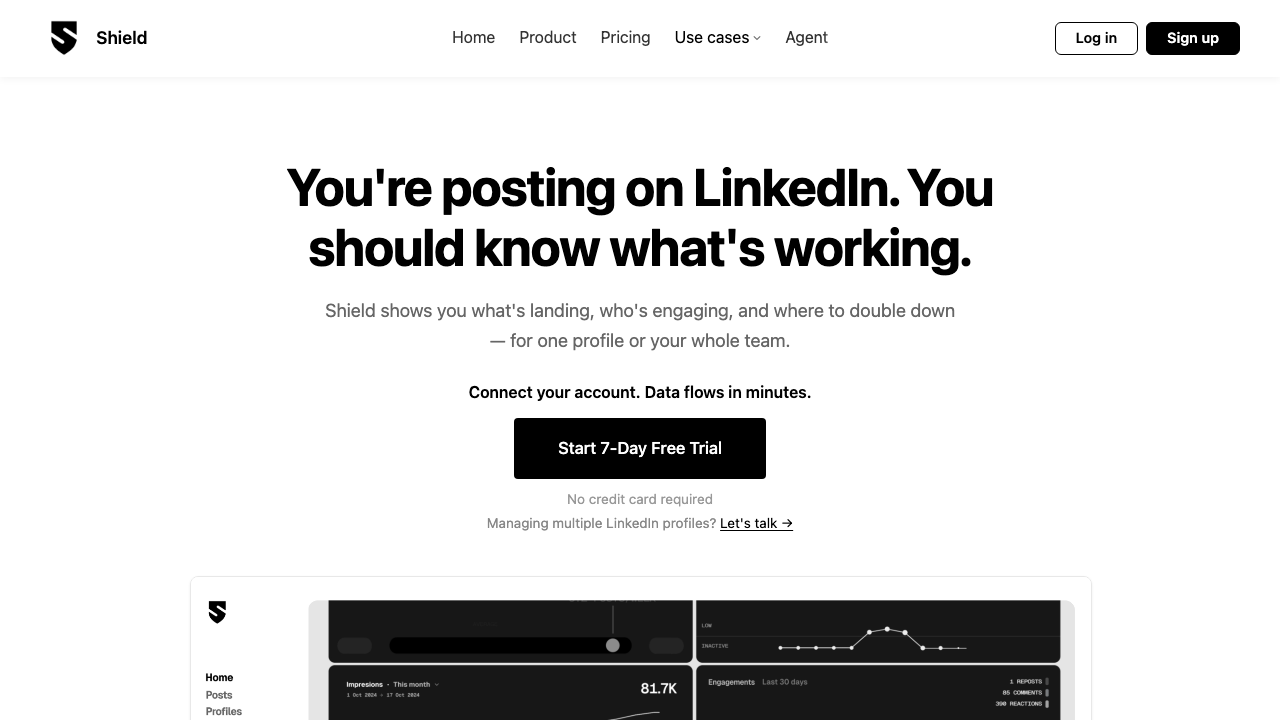
Shield is the right Taplio alternative if you already write your own posts and the only thing you need is better data. LinkedIn's native analytics are shallow: 28 days of history, no posting time optimization, no audience trend analysis. Shield gives you historical data, posting time recommendations based on your actual audience, and deeper engagement metrics.
At $25/mo it is significantly cheaper than Taplio's $39-149/mo range. You pair it with any scheduling tool (Buffer is fine for $6/month).
3. AuthoredUp
Category: LinkedIn writing tool and composer Pricing: $19.95/mo Individual; $14.95/profile/mo Business Best for: Writers who want better formatting and post management
AuthoredUp is a Chrome extension that improves LinkedIn's native composer with rich text formatting, post preview, saved templates, and a snippet library. If your Taplio frustration is specifically about AI content quality rather than scheduling or analytics, AuthoredUp is the answer: it makes writing your own posts easier, not less necessary.
It pairs well with Shield Analytics ($25/mo) for a $45-50/mo combination that beats Taplio's value proposition for creators who write well and just need better tools.
4. Supergrow
Category: LinkedIn content creation + scheduling + analytics Pricing: $19/mo Starter; $29/mo Pro; $139/mo Teams Best for: Budget-first creators wanting Taplio-style features at lower cost
Supergrow is the direct budget competitor to Taplio. Voice-learning AI that adapts to your writing style, scheduling, and analytics in one product. The $19/mo Starter is less than half Taplio's entry price.
Trade-offs: smaller user base, newer product, AI quality variance mentioned in some reviews. For creators who cannot justify Taplio's pricing and want the all-in-one approach, Supergrow is the honest first step.
5. Hypefury
Category: Twitter/X automation + LinkedIn scheduling Pricing: $19/mo Starter; $49/mo Creator; $99/mo Premium Best for: Creators who are primarily active on X and also post on LinkedIn
Hypefury is excellent at X (thread tools, evergreen recycling, scheduling). LinkedIn is a secondary channel: cross-posting and scheduling work well, but the LinkedIn-native depth is not comparable to Taplio. If you are X-first and LinkedIn-second, Hypefury is the right tool. If LinkedIn is primary, Taplio or Supergrow is more focused.
6. Buffer
Category: Multi-platform scheduling Pricing: Free; from $6/channel/mo Best for: Creators who want basic scheduling across multiple platforms without LinkedIn-specific features
Buffer is the right answer if your LinkedIn content strategy is simple (post regularly, measure clicks) and the LinkedIn-specific AI and analytics of Taplio are not relevant to your goals. Free tier for basic scheduling. $6/channel adds analytics. No AI content generation.
For personal brand builders who write their own content and just need a reliable post queue, Buffer is the minimum viable tool.
Where OutX fits in (content creators vs pipeline builders)
LinkedIn creators split into two groups: those who want followers and engagement, and those who want pipeline from LinkedIn.
For the pipeline-focused group, Taplio's content creation features are necessary but not sufficient. Publishing content is how you get discovered. But the actual pipeline conversations often start when you respond to a relevant post, not when someone reads your post.
OutX is the listening and engagement layer: monitoring LinkedIn for the conversations happening around your category and helping you participate in them. Running Taplio and OutX together gives you both sides of LinkedIn pipeline: original content that brings people to your profile, and conversation engagement that generates direct pipeline conversations.
Bottom line
- Pure analytics, you write your own posts: Shield at $25/mo.
- Better LinkedIn writing tools: AuthoredUp at $19.95/mo.
- Taplio features at lower price: Supergrow at $19/mo.
- X-first creator who also publishes on LinkedIn: Hypefury.
- Basic multi-platform scheduling: Buffer.
- LinkedIn engagement that drives pipeline, not just content: OutX.